

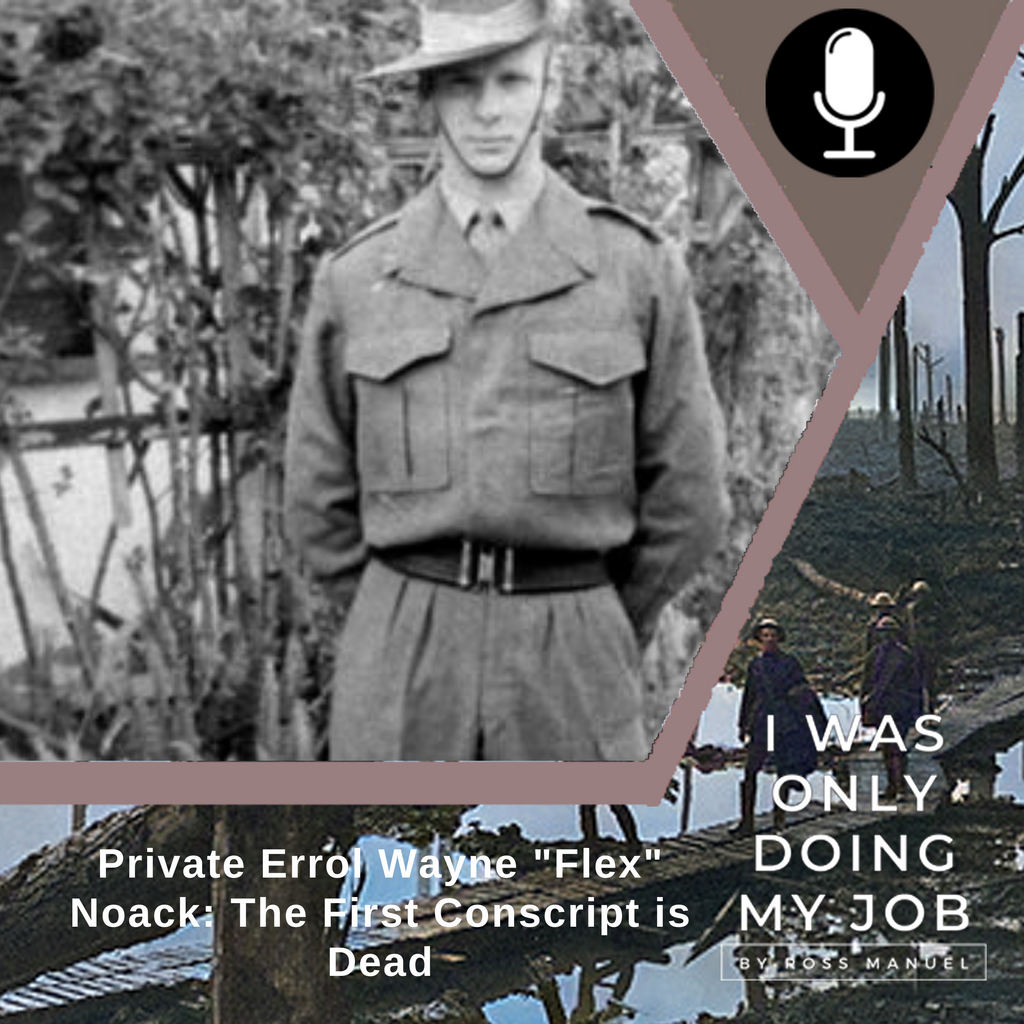
Private Errol Wayne "Flex" Noack: The First Conscript is Dead
Vietnam War
Summary
24-MAY-1966. While serving with B Company 5th Battalion Royal Australian Regiment, Australian Regular Army, National Serviceman Private Errol Wayne Noack served as a section machine gunner during the Vietnam War. He was killed during his first military operation two weeks after arriving in-country and would go into the history books as the first Australian National Serviceman killed in Vietnam.
His death would polarise Australian society about a war that was increasingly becoming unpopular, and his position as the first conscript killed in that war would serve as a rallying cry for those against mandatory military service.
—
Send in a voice message: https://anchor.fm/iwasonlydoingmyjob/message
Show Notes
Errol Wayne Noack, was born on 28 March 1945 in North Adelaide, the only child of Walter Henrich Noack, a mechanic and his wife Dorothy Muriel Wilson. Originally named Errol Wilson Noack, however, following the breakdown of his parent’s marriage and subsequent divorce in 1947, his middle name was changed to Wayne.
Aside from a brief period where he lived with his aunt and uncle; Herb and Lois Noack, he would be raised solely by his father.
Despite the rather acrimonious breakdown of his parents’ marriage, Noack apparently still remained in contact with members of his mother’s family, including spending summers with maternal cousins and grandparents.
He was brought up in the Lutheran faith. As he grew up, he joined the staff of his local Sunday school and participated in many of the youth activities.
Due to interruptions in his schooling, it wouldn’t be until 1963 at the age of 18 that Noack would complete his intermediate year of schooling, at Concordia College in Highgate Adelaide where he was academically an average student. He would go on to be a driver at the SAFCOL cannery in Port Lincoln, before he moved to Adelaide to briefly work for the Myer department store as a salesman and model only to return home to work with his father as a tuna fisherman.
After four months of father and son working together, Noack’s number was called in the Birthday Ballot and his draft papers arrived.
While Australia always had provisions for compulsory military service as outlined in the 1903 Defence Act, it had only been activated twice before the establishment of the Australian Regular Army in 1947; just prior to both World Wars. One aspect of the 1903 Act that remained consistent was that all Australian service personnel could not be compelled to serve outside of Australia’s territorial waters, and any permanently raised unit couldn’t be deployed overseas, with the intent that the Defence Act was to raise a purely defensive force. This is what necessitated the raising of the all-volunteer Australian Imperial Forces for both global conflicts, and the conscription referendums of the First World War. The National Service Act 1951 was the third activation of the conscription clause of the Act and was enacted due to the rise of communist insurgencies in South-East Asia and the Korean War, thus calling on compulsory military service but was repealed in 1959. The fourth and final time that compulsory military service has been called as of recording was the National Service Act of 1964, which required all 20-year-old males to register for military service for a period of two years. This excluded married men, and those already in the Permanent or Citizens Military Force, those who worked in theological professions, such as members of the clergy, and Aboriginal and Torres Strait Islander peoples. Initially, draftees could elect to serve in either the Australian Regular Army and be sent where the military required them to, or to serve in the Citizens Military Force and do their service domestically. The year after it was implemented the Menzies Government enacted a change that removed the distinction between the two branches of the Australian Army.
What this meant compared with previous amendments to the 1903 Defence Act was that it removed the requirement that those who were called up for military service had to volunteer to be sent overseas, meaning that all draftees and those that enlisted voluntarily would be sent wherever the military required them including into combat.
As the number of Australian males turning 20 every year vastly exceeded the Australian Regular Armies operational requirement and its ability to train a Birthday Ballot system was instituted in which all males whose birthdays had been drawn via a lottery would then receive a notice from the Department of Labour and National Service, outlining the date they needed to present to basic training and gave them the necessary information if they wished to seek an exemption, of which there were very few accepted reasons.
After receiving his call up, Noack visited Adelaide Labor MP Clive Cameron to ask what he should do. Cameron who remembered him as a fine young man asked him if the Lutheran faith allowed him to kill another human being. When Noack said no, the MP advised him to register as a conscientious objector. Noack decided against this course of action and then went to his local pastor and friend, G.E. Fischer: “I don’t want to go to war, but I must obey the call to duty. I will go and do my best.” According to his uncle Herb, “since there was nothing, he could do about it, he decided to make the most of it.”
Even with that declaration, Noack didn’t take to soldiering very well. He presented to Keswick Barracks on 30 June 1965 to commence his service as a nasho or national serviceman in which he was among the first intake of national servicemen, he was sent to the 2nd Recruit Training Battalion at Puckapunyal, Victoria, for basic training. He had several disciplinary infractions for comparatively minor issues but was rated a competent soldier. His mates gave him the nickname “Flex”, referencing his large biceps, and by all accounts he was considered an easy-going guy.
He was posted to the newly raised 5th Battalion, Royal Australian Regiment, and was allotted to 5 Platoon, B Company. Owing to his height of six-foot-one, he was given the role of section machine-gunner. Further training followed, including at Canungra Queensland, where the men learned about operating in a jungle environment.
While on exercises in Western Australia to sit for selection as a reinforcement for the Special Air Service, he was reported to have lacked enthusiasm and application, nor did he have the standards of self-discipline, which rendered him not acceptable to join the special forces regiment. While in WA he also apparently began a relationship with local girl Sandra Harrison, who held the belief that they would marry at the completion of his national service.
For his final leave Noack stayed with his father in their caravan at Port Lincoln, where he belatedly celebrated his 21st birthday on 8 May 1966, by taking a final swim at nearby Kirton Point before driving to Adelaide. Here Noack took Holy Communion at the family’s church before being taken to the airport.
On 8 May 1966 Noack was flown to Vietnam with a number of his comrades. There he took part in several patrols and training exercises in the surrounding jungles of the Australian logistical base of Vung Tau, a port city on a peninsula in southern Vietnam taken over by the 1st Australian Logistical Support Group to serve as a depot for all Australian supplies and reinforcements into and out of Vietnam. After his first week in Vietnam, he wrote to his aunt Lois, mentioning the constant rain, and hot tropical sun that dried things out quickly, he also apologised for his writing and grammar, as he had consumed quite a few beers after returning from a patrol. On 24 May 5RAR was taken by helicopter from Vung Tau to a landing zone near Nui Dat and immediately took part in the battalion’s involvement in Operation Hardihood.
Operation Hardihood was a joint Australian-United States Army security operation from 16 May-6 June 1966 and comprised of the 1st and 5th Battalions Royal Australian Regiment and the 503rd Infantry Regiment, 173rd Airborne Division United States Army within the Phuoc Tuy Province around Nui Dat for the establishment of the base area for the newly raised 1st Australian Task Force, this base would be from which all further Australian operations would be conducted from. This operation was the result of the Australian Government of the time’s announcement that the current Australian military presence in Vietnam would be expanded from a single battalion to a full task force, comprising of armour, aviation, engineers, and artillery support, prior to this point, Australian forces had been slotted within the United States Army force organisation chart, and this change would allow for greater autonomy in Australian operations.
5RAR was tasked from 24 May to clear the area around Nui Dat of Viet Cong in an area of 6,000 metres east and north-east of Nui Dat. The battalion’s A and B Companies were tasked with clearing to the northern edge of the area of operation while its C and D Companies cleared to the north and south. The terrain the Australian troops were operating in was thick with vegetation that limited visibility to eighteen meters in some places which made movements incredibly slow and difficult to orientate themselves. To aid in this, each company was given natural boundaries to operate such as tracks or streams instead of arbitrary lines drawn on a map so that the patrols could see clearly when they reached the limit of their area.
After a full day of stressful patrols in which A Company encountered sporadic groups of Viet Cong, B Company, of which Noack was assigned, having cleared just over one and a half kilometres of thick country set up a harbour position near the crest of Hill 72 at 5pm. A harbour position was a defensive formation that allowed for further operations while also serving as a rendezvous point for patrols into enemy territory while also giving the company a place to rest. The most common kind of patrol harbour is a triangle configuration as it allows for all-round defence.
An hour later, once the patrol harbour had been established and listening posts set up, parties were dispatched to a nearby creek to refill the companies’ depleted canteens. It is at this point where accounts on what happened next start to differ, with some accounts listing Noack as manning a listening post near the creek, while others have him present in these water parties, but what is known is that following the return and dissemination of the now refilled canteens, Noack approached Private Kevin Borger, enquiring about which of the two kinds of water purification tablets he had been issued to use in the water bottle when the call came out to hit the ground. Almost immediately Noack was struck by a burst of submachine gun fire. His section immediately returned fire in the direction they believed the fire to be coming from, believing it to be a Viet Cong Patrol until Corporal George Gilbert, Noack’s section commander apparently noticing something was amiss called out “Stop firing we are Australian’s.”
The differing accounts continue from this point with the official unit account of the action stating the Noack stood during the pause to change positions when he was shot in the abdomen, while personal interviews conducted of Private Kevin Borger and Private John O’Callaghan, the two men who were with Noack at the time he was shot state that he was hit in the initial salvo. Whichever event occurred once the shooting ceased it was quickly realised that both A and B Companies had, unbeknownst to each other, approached the same creek junction from opposite directions, and A Company had fired on the B Company listening post.
A medic was immediately sent forward and a stretcher set up to return Noack to within the patrol harbour while a medivac ‘Dust Off’ was called. Over the next forty minutes the company waited tensely, expecting a Viet Cong attack while Noack prayed, and even though his wounds did not look serious its apparent that he knew that he was dying. He told his brothers beside him “I’ve had it.” After those tense forty minutes an American Iroquois Helicopter landed at a nearby landing zone, and an African American medic jumped out and immediately tended to Noack’s wounds before bundling him into the helicopter for transport to the 36th Evacuation Hospital at Vung Tau. At 10pm 24 May 1966, B Company would receive word, that Private Errol Wayne Noack died of his wounds while enroute to the hospital. In doing so he was the First National Serviceman to die in Vietnam, he was just 21 years old and had been in country for two weeks and two days.
Understandably the death of the first national serviceman, the first conscript was going to court controversy especially considering the possibility that that death was at the hands of a fellow Australian. With the possibility of a blue-on-blue death, Major General Kenneth Mackay, commander, Australian Force Vietnam, ordered all communications with Australia stop while an autopsy was held and senior officers made a series of urgent visits to the men in the field, though according to Privates Borger and O’Callaghan the men of Noack’s section were never interviewed about what happened. Three days after his death General Mackay made the announcement that Noack had been killed by a Viet Cong Squad, even if his brothers in his section disagreed with that assessment.
Now no war is universally accepted by an entire population, there is always some part of society that is against war, even in historically supported conflicts like the two world wars, there was people who were against the fighting, and Vietnam probably more specifically this was the case. Now in Australia the war had the benefit of support from a significant portion of the population at the onset, but Noack’s death seemed to serve as a rallying point for the anti-war/anti-conscription crowd, with placards bearing the phrase “The First Conscript is Dead” starting to appear at sit ins, protest marches and vigils apparently within hours of the news breaking. It is interesting that for the most part, these signs didn’t mention Noack as a person, only his position as a national serviceman, as if his position was more important than the man occupying it, though I have seen on more than one occasion protests bearing the signs “Who really killed Noack.” Which could be seen either as an inditement of the government sending Noack to war, or that the alternate belief that Noack had been killed by a fellow Australian had made their way out into the community despite the Army’s best efforts.
Noack’s body was returned to Adelaide for burial on 31 May 1966 after initially arriving in Perth. At the beginning of 1966, the Australian Government made the decision to repatriate all of Australia’s war dead, changing a policy that had existed since before Federation that outlined that Australian War dead would be interred in Commonwealth War Cemeteries close to where they fell.
The same day his remains arrived in Adelaide it was reported that he would receive a military funeral with full honours conveyed the following day at the Bethlehem Lutheran Church in Adelaide, where he had been confirmed and had spent time as a youth leader. His good friend Pastor Fischer oversaw the service, in his opening address, he addressed the publics controversy surrounding his friends death. “This is first and foremost a burial service. For many different reasons it has become a funeral of national attention and interest... Errol's death has pin-pointed and high-lighted grave national and international issues.”
The grounds were packed with people paying respects, as was the road to Centennial Park Cemetery, where he was laid to rest. While the media had initially reported that Sandra Harrison his girlfriend from Perth would be in attendance, this didn’t eventuate following a request from his father citing that the two had never met beforehand and it wouldn’t have been appropriate considering the setting.
Errol’s mother Dorothy was either not advised of his funeral, or wasn’t invited, but was tracked down by the media for comment on 1 June, the day of his funeral; her responses were published alongside editorials and comments about the war. She would regularly attend anti-conscription marches speaking as the mother of the first slain conscript, his father Walter however, having lost his best mate and only son never truly recovered from the news, and only wished that Errol’s death would not become used as political propaganda, sadly his wishes were not honoured as both sides of Australian politics highlighted Errol’s death to either support or to lambast either the war, or the practice of national service.
In 1989, the South Australian Returned Services League honoured Errol with the opening of Errol Noack House in Mitchell Park, South Australia. The facility commemorates Errol's war service and continues to provide emergency accommodation for Vietnam and other war veterans and their families.
Despite the Army’s initial statement that Noack was killed by a Viet Cong squad, it is established in the official history, as well as the unit history of 5RAR and in more contemporary writings on this incident, that it seems more probable that he had been killed by friendly fire.
Compulsory Military Service would continue for another seven years before the newly elected Whitlam Government repealed in December 1972, after 63,735 national servicemen served in the Army, of which 15,381 were deployed to Vietnam and regrettably approximately 200 were killed, starting with a 6 foot tuna fisherman from Port Lincoln. And while Conscription remains part of Article four of the 1903 Defence Act, as recently as 1992 with the Defence Legislation Amendment Bill 1992 saw a review of the provisions that allowed for national service in a more modern military as well as how and when it could be called.
Despite Errol Noack’s misgivings about national service, no one can say that he didn’t do his job, even if he paid the supreme sacrifice
Reference List
Bibliography
5RAR Association. “Noack E. W. – 5th Battalion – the Royal Australian Regiment Association.” 5rar.asn.au, 2024. https://5rar.asn.au/noack-e-w/.
———. “Operation Hardihood – 5th Battalion – the Royal Australian Regiment Association.” 5rar.asn.au, 2024. https://5rar.asn.au/operation-hardihood/.
———. “To Nui Dat with the 173rd Airborne Brigade – 5th Battalion – the Royal Australian Regiment Association.” 5rar.asn.au, 2024. https://5rar.asn.au/to-nui-dat-with-the-173rd-airborne-brigade/.
Australian War Memorial. “Operation Hardihood DPR/TV/388.” Awm.gov.au, 2026. https://www.awm.gov.au/collection/F03772.
———. “Private Errol Noack | Australian War Memorial.” www.awm.gov.au, n.d. https://www.awm.gov.au/learn/memorial-boxes/2/case-studies/errol-noack.
Australian War Memorial, and Michael Kelly. “Eyewitness Accounts of Private Errol Noack’s Wounding | Australian War Memorial.” www.awm.gov.au, September 27, 2019. https://www.awm.gov.au/articles/blog/eyewitness-accounts-private-errol-noacks-wounding.
———. “The Last Post Ceremony Commemorating the Service of (4717546) Private Errol Wayne Noack, 5th Battalion, Royal Australian Regiment, Vietnam.” Awm.gov.au, 2026. https://www.awm.gov.au/collection/C2104920.
DVA: ANZAC Portal. “Settling in Nui Dat.” Anzac Portal, January 8, 2019. https://anzacportal.dva.gov.au/wars-and-missions/vietnam-war-1962-1975/events/phuoc-tuy-province/nui-dat/settling-nui-dat.
Knott, John. “Noack, Errol Wayne (1945–1966).” Anu.edu.au, 2000. https://adb.anu.edu.au/biography/noack-errol-wayne-11249.
National Library of South Australia. “Correspondence of Walter Noack.” State Library of South Australia, n.d. https://digital.collections.slsa.sa.gov.au/nodes/view/2511.
Staff reporter. “From the Archives, 1966: First Conscript Killed, More Troops Sail for Vietnam.” The Sydney Morning Herald, May 24, 2021. https://www.smh.com.au/national/nsw/from-the-archives-1966-first-conscript-killed-more-troops-sail-for-vietnam-20210520-p57tq2.html.
Trove the Online Newspaper Archive. “The Canberra Times (ACT : 1926 - 1995) - 27 May 1966 - P4.” Trove, 2026. https://trove.nla.gov.au/newspaper/page/14522971.
Virtual War Memorial Australia. “Errol Wayne (Flex) NOACK.” vwma.org.au, n.d. https://vwma.org.au/explore/people/21070.